

Introduction
In the fast-evolving world of manufacturing, innovation is the key to staying competitive. One such breakthrough that is transforming materials science is Electron Beam (E-Beam) Technology. While widely adopted in developed countries, Indian manufacturers are only beginning to tap into its full potential. A core application—polymer crosslinking—offers significant enhancements in material strength, heat resistance, chemical stability, and durability.
Let’s explore how E-Beam technology boosts material performance through crosslinking and why it presents a golden opportunity for India’s industrial ecosystem.
What is E-Beam Crosslinking?
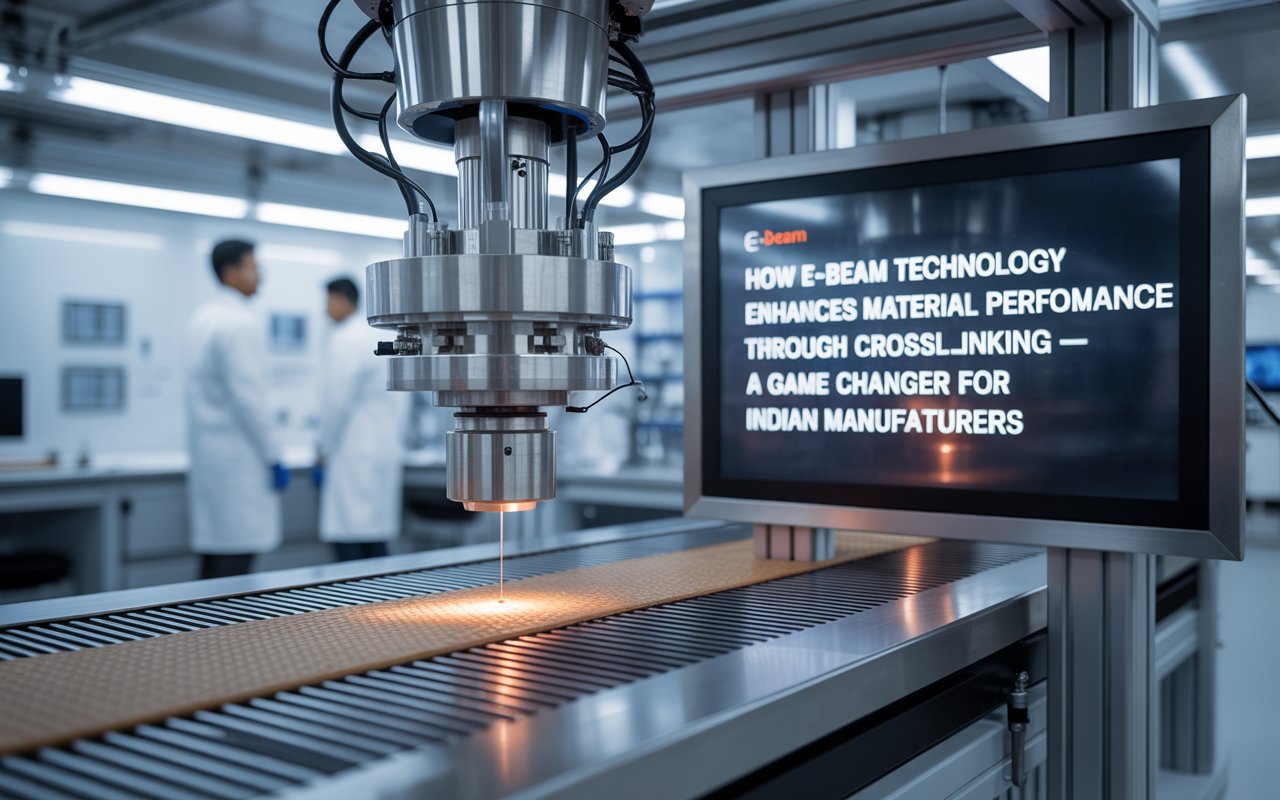
E-Beam crosslinking is a clean, efficient process where high-energy electrons are used to induce covalent bonds between polymer chains. Unlike chemical methods, it doesn’t require additives or catalysts—making it a dry, eco-friendly process that enhances polymers without altering their appearance or basic structure.
This technology is widely used for:
-
Wires and cables
-
Heat-shrinkable tubes
-
Automotive components
-
Medical devices
-
Packaging films
How E-Beam Crosslinking Enhances Material Properties
1. Improved Thermal Resistance
Crosslinked polymers can withstand higher temperatures without deformation. This is crucial for industries like automotive, electronics, and aerospace, where thermal stability is vital.
2. Enhanced Mechanical Strength
The crosslinked network improves tensile strength, abrasion resistance, and load-bearing capacity. Materials last longer, perform better, and reduce maintenance costs.
3. Superior Chemical and Environmental Resistance
E-Beam-treated materials show better resistance to oils, solvents, moisture, and radiation—ideal for medical devices, outdoor applications, and industrial environments.
4. Reduced Creep and Deformation
Crosslinked polymers maintain dimensional stability under stress, making them reliable for precision parts in manufacturing and construction.
Why Indian Manufacturers Should Embrace E-Beam Technology
India’s manufacturing sector is rapidly growing, but to compete globally, there’s a need to innovate and upgrade material performance. Here’s how E-Beam technology can help:
✅ Import Substitution
Products with high-performance polymers are often imported. E-Beam technology can empower local manufacturers to produce these in-house, reducing dependency on imports.
✅ Cost Efficiency
Though the initial setup may seem significant, E-Beam irradiation reduces material waste, increases product lifespan, and lowers production costs in the long run.
✅ Sustainability
As global standards move toward green manufacturing, E-Beam’s chemical-free, energy-efficient process positions Indian companies as eco-conscious exporters.
✅ New Product Development
E-Beam crosslinking enables R&D for next-gen products in healthcare, electronics, packaging, and defense—unlocking new revenue streams.
Success Story: How Global Players Leverage E-Beam
Companies like Raychem, 3M, and Sumitomo use E-Beam crosslinking to manufacture high-performance components that lead their industries. Indian firms can follow suit—especially as local E-Beam service providers like Avik Ebeam Technologies make access easier than ever before.
Final Thoughts
E-Beam crosslinking isn’t just a technology—it’s a strategic investment in product quality, performance, and market differentiation. Indian manufacturers aiming for global competitiveness should actively explore and integrate this powerful process.
Whether you’re in automotive, electrical, medical, or packaging, E-Beam crosslinking can give your materials the edge they need.
Ready to Enhance Your Material Performance?
Partner with a trusted E-Beam service provider like Avik Ebeam Technologies to explore crosslinking solutions tailored to your product. Let innovation lead your growth! Contact Us